

KINS DESK
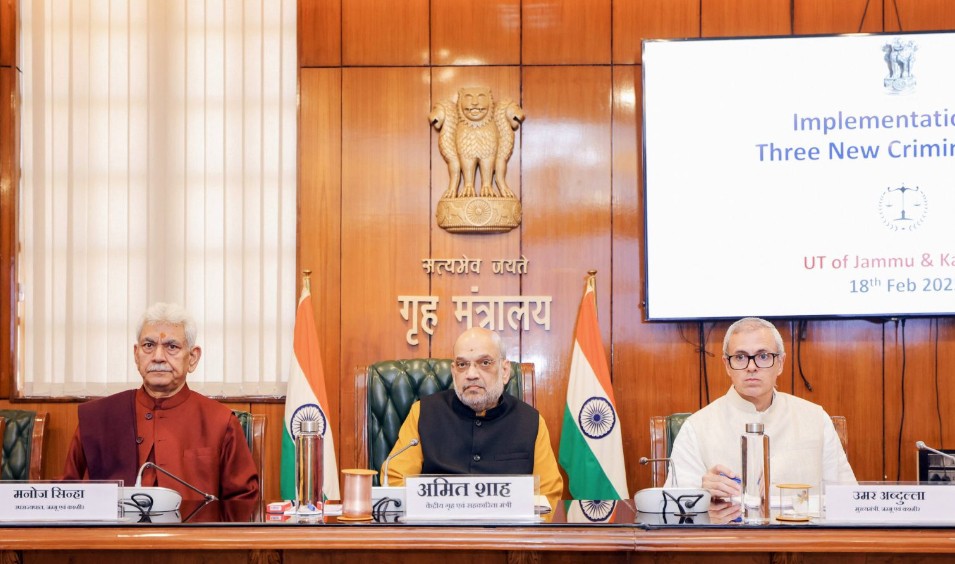
Srinagar, Feb 18 (KINS): Union Home Minister Amit Shah on Tuesday assessed the implementation of the new criminal laws in Jammu and Kashmir in a high-level meeting attended by Chief Minister Omar Abdullah and Jammu and Kashmir Lieutenant Governor Manoj Sinha.
Amit Shah emphasized that the Jammu and Kashmir administration must ensure the full implementation of the three new criminal laws in the Union Territory by April 2025.
The Home Minister stressed that, with the security situation stabilizing in the Union Territory, the focus should now shift to safeguarding the rights of the people.
During the meeting in New Delhi, Shah directed the UT administration to prioritize the complete enforcement of the new laws by April.
He also highlighted the need for a change in the mindset of both police personnel and the administration, alongside efforts to raise public awareness about the new legal provisions.
Amit Shah emphasized the need to leverage technology for ensuring speedy justice under the three new criminal laws.
He pointed out the urgent requirement to utilize the Trial in Absentia provision in the Union Territory and highlighted the importance of holding police officers accountable to expedite the filing of charge sheets.
The review meeting, which assessed the implementation and current status of various provisions related to police, prisons, courts, prosecution, and forensics in Jammu and Kashmir, also focused on improving efficiency in the criminal justice system.
Home Minister Amit Shah urged that every police station in J&K make full use of the National Automated Fingerprint Identification System (NAFIS) to enhance investigative capabilities.
He further stressed the 100% training of investigating officers on the new laws should be completed at the earliest.
On provisions related to terrorism and organized crime, Shah stated that decisions should only be made after thorough scrutiny at the Superintendent of Police level, with strict monitoring to prevent misuse of these provisions.
Praising the J&K administration for its efforts in implementing the new laws under challenging circumstances, Shah called for regular progress reviews on the implementation of the three laws at varying levels: monthly at the Chief Minister’s level, fortnightly at the Chief Secretary’s level, and weekly at the Director General of Police’s level.
Despite law and order being under the direct control of the Central government since the erstwhile state’s bifurcation into the union territories of Jammu and Kashmir and Ladakh in 2019, CM Omar Abdullah participated in the discussions.
The meeting, held at North Block, was also attended by senior officials from both the Central and J&K governments, officials said.
The review focused on the transition to the Bharatiya Nyaya Sanhita, Bharatiya Nagarik Suraksha Sanhita, and Bharatiya Sakshya Adhiniyam, which replaced the Indian Penal Code, Code of Criminal Procedure, and Indian Evidence Act of 1872, respectively.
The new laws, which came into effect on July 1 last year, mark a significant overhaul of India’s criminal justice system.
Home Minister has previously conducted similar reviews in several states, including Uttar Pradesh, Haryana, Uttarakhand, Madhya Pradesh, and Gujarat.(KINS)
