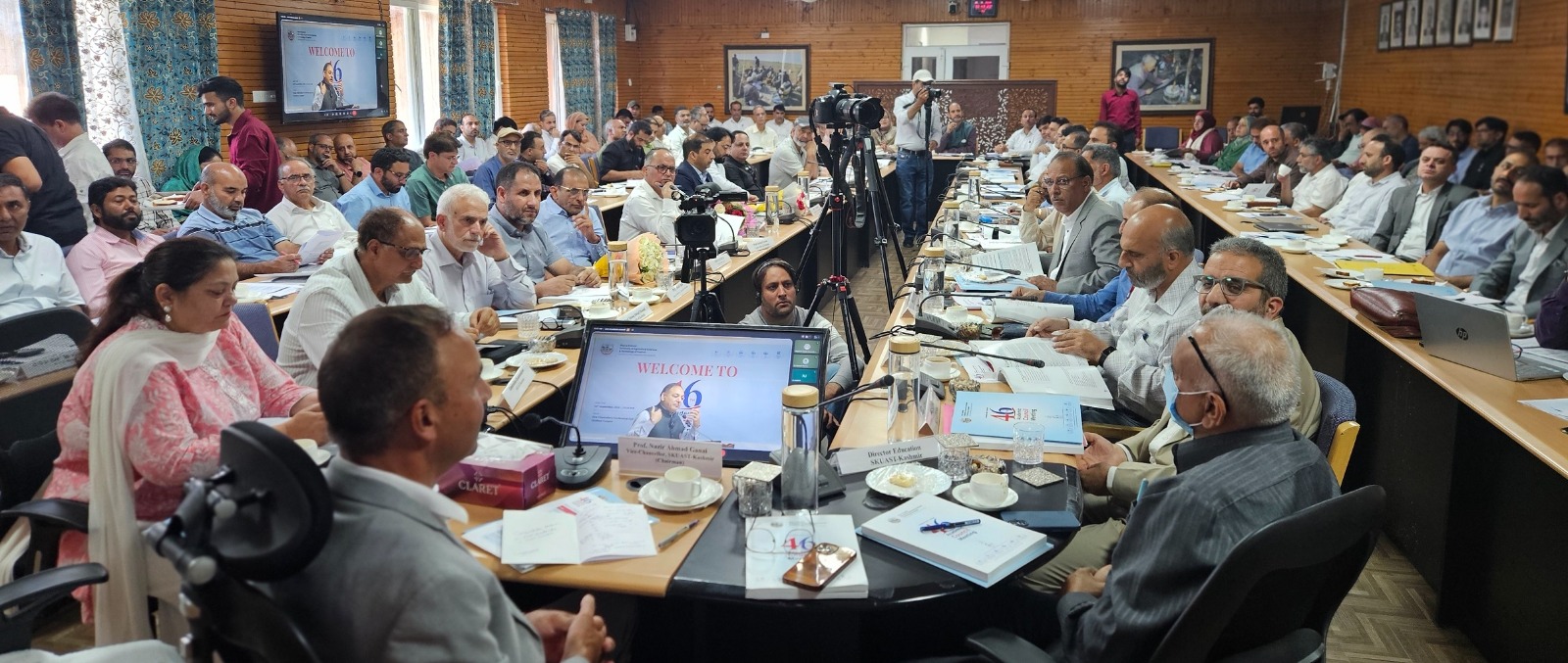
SKUAST-K holds 46th Academic Council meeting
Sets roadmap to become India’s first global agricultural university
SHALIMAR, SEPTEMBER 10: The 46th Academic Council meeting of Sher-e-Kashmir University of Agricultural Sciences and Technology of Kashmir (SKUAST-K) was held today at the Vice-Chancellor’s Conference Hall, Main Campus, Shalimar, with deliberations focused on academic transformation, research and innovation for University’s transition from ‘National to Global’ by 2030.
The meeting was chaired by Prof Nazir Ahmad Ganai, Vice-Chancellor, SKUAST-K and Chairperson of the Academic Council, and attended by members of the Academic Council, representatives from sister universities and institutions, and officers and heads of various Divisions of the University. Shri Ram Niwas, Commissioner/Secretary to the Government, Higher Education Department, Government of Jammu and Kashmir, attended the meeting as special guest.
In his address, Prof Nazir Ahmad Ganai said the University has achieved the goal set in 2022 of moving from ‘Local to National’ and was now repositioning its goalpost from ‘National to Global’. He said that the next phase of transformation would be driven by six key pillars: student diversity, faculty diversity, curriculum transformation, research and innovation, world-class infrastructure, and financial sustainability.
Prof Ganai outlined the milestones to be achieved by 2030, including increasing the international students enrollment to 5% and students from other States/UTs of the country to 35%, taking the University’s IPR portfolio to over 250 and H-index to 250+, and strengthening faculty diversity by attracting 50+ faculty members from outside the Union Territory, including Professors of Practice and Adjunct Faculty.
He further stressed the need for a sustainable mountain development policy, keeping in view the changing global climatic scenario and the growing challenges confronting mountain ecosystems. He said the University should contribute its expertise towards developing sustainable and climate-resilient approaches for mountain agriculture and development.
Prof Ganai expressed gratitude to the Lieutenant Governor, Shri Manoj Sinha; Chief Minister, Shri Omar Abdullah; Minister for Agriculture, Shri Javid Ahmad Dar; Chief Secretary, Chief Secretary, Atal Dulloo; other Administrative Secretaries; and ICAR for their continued support and guidance to the University. He also thanked Shri Ram Niwas for his valuable suggestions and inputs during the Council deliberations, which, he said, would help the University advance its vision of becoming a globally recognized institution.
Addressing the Council, Shri Ram Niwas said SKUAST-K has demonstrated how an agricultural university could take on a larger role in the higher education landscape and acknowledged the University’s shift in its goalpost from national to the global level. He said the proposed Centre for Faculty Training and Pedagogy at SKUAST-K has the potential to serve as a model for universities across the country. He also suggested the creation of an Indian Teachers Service on the lines of other national services such as IAS, IFS and IES, to strengthen academic capacity-building across the country.
Shri Ram Niwas further suggested that universities should develop predefined five- or ten-year action plans, with clear goals and measurable outcomes, to provide a structured roadmap for institutional development and long-term transformation.
Earlier, Prof. Mohd. Altaf Bhat, Director Education, SKUAST-K, delivered the welcome address. Prof. Azmat Alam Khan, Registrar and Member Secretary, Academic Council, presented the University Progress Report, followed by the Agenda and Action Taken Report of the previous Academic Council meeting.
The meeting also witnessed the release of the revised uniform format for postgraduate theses, prepared by Dr Heena Hamdani, aimed at ensuring greater uniformity and standardisation in thesis preparation and submission at the University. A Ph.D thesis of Agricultural Engineering student Er. Riyaz Ashraf was also displayed as a model for other research scholars, particularly in view of its additional chapter focusing on research outcomes.
Umer Ibni Assad, Deputy Registrar (Academics), proposed the vote of thanks.
SKUAST-K holds 46th Academic Council meeting