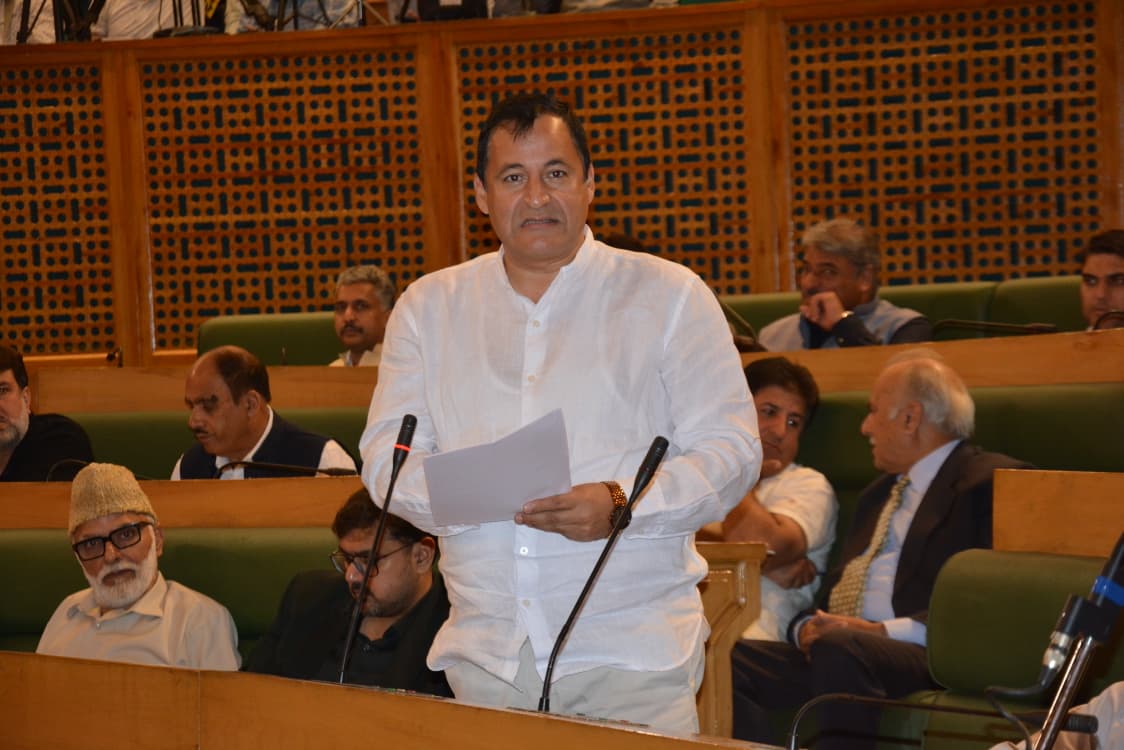
Govt intensifies measures to curb spurious pesticides, promote safe and judicious use in J&K: Javid Dar
SRINAGAR, SEPTEMBER 24: Minister for Agriculture Production, Rural Development and Panchayati Raj, Cooperative and Election Department, Javid Ahmad Dar, today informed the Jammu and Kashmir Legislative Assembly that the government has put in place a comprehensive regulatory and enforcement mechanism to prevent the sale and use of spurious and substandard pesticides and to promote their safe and judicious application across Jammu and Kashmir.
The Minister was replying to a Calling Attention Motion moved by MLA Waheed Ur Rehman Para on concerns over rising cancer patient graph and alleged risks from spurious pesticides in major agricultural and horticultural areas.
The Minister stated that the Agriculture Production Department is taking stringent measures under the Insecticides Act, 1968, to regulate the sale and use of pesticides and prevent the circulation of spurious and sub-standard products. He further informed that two Quality Control Laboratories, one each at Srinagar and Jammu, are functional for testing the quality of pesticides. The existing enforcement and regulatory mechanism is also being strengthened to ensure strict compliance with prescribed quality standards, he added.
Giving details of enforcement action, the Minister said that during 2025–26, 5,772 pesticide samples were tested, of which, 85 were found sub-standard. Action taken included 93 show-cause notices, 52 prosecutions, 22 FIRs and recovery of ₹ 70,000 in fines.
During 2026–27, 1,658 samples have so far been tested, with 66 found sub-standard. Consequently, 19 licences were cancelled/suspended, 19 prosecutions initiated, three FIRs registered and ₹1.33 lakh recovered as fine.
The Minister also informed the House that 32 highly toxic pesticide formulations have been banned/restricted in J&K in accordance with the advisories of the Government of India.
Emphasising responsible pesticide use, Javid Dar said that the government is ensuring strict adherence to recommended doses, crops, target pests, waiting periods and application methods. He said the farmers and pesticide applicators are being sensitised on proper selection, dosage, timing, safe handling, use of Personal Protective Equipment (PPE) and disposal practices.
The Minister also highlighted the promotion of Integrated Pest Management (IPM) to reduce excessive dependence on chemical pesticides. During 2025–26, 520 IPM Farmer Field Schools were conducted in major horticultural districts, including Shopian, Pulwama, Baramulla, Kulgam and Anantnag, to promote scientific pest management and safe pesticide use.
Under the Holistic Agriculture Development Programme (HADP) and Mission for Integrated Development of Horticulture (MIDH), the government is promoting organic farming and judicious use of agro-chemicals.
The Minister said that around 1.15 lakh Soil Health Cards have been issued to promote balanced use of agricultural inputs, while a State Pesticide Residue Testing Laboratory is at the final stage of establishment. He said fruit growers are being advised to use only registered pesticides from licensed dealers, follow prescribed doses and waiting periods, use protective equipment and adhere to departmental advisories on safe handling, storage, weather conditions and application.
Referring to pesticide-residue monitoring, Javed Ahmad Dar informed the House that the NABL-accredited Research Centre for Residue and Quality Analysis at SKUAST-Kashmir regularly tests fruits, vegetables and field crops under the MPRNL programme of the Ministry of Agriculture & Farmers Welfare, Government of India. He said residues generally remain within prescribed Maximum Residue Limits (MRLs), though occasional exceedances are detected.
The Minister said a comprehensive, science-based study involving the Agriculture Production, Health & Medical Education departments, SKUAST-Jammu, SKUAST-Kashmir, SKIMS and SMHS could assess pesticide exposure, residue levels, usage patterns and related health data to strengthen risk assessment and preventive measures.
Referring to the Committee on Environment’s recommendations regarding pesticide exposure and malignant brain tumours, Dar said SKUAST-Jammu had recommended a coordinated, multi-sectoral approach to minimise risks from indiscriminate and unsafe pesticide use.
Govt intensifies measures to curb spurious pesticides, promote safe and judicious use in J&K: Javid Dar