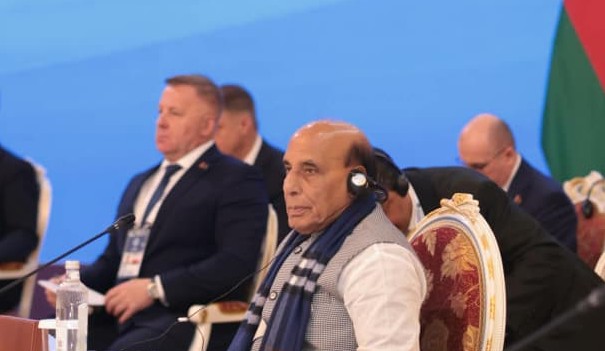
Srinagar, Oct 20 (KINS): Defence Minister Rajnath Singh on Tuesday called upon member states of the Shanghai Cooperation Organisation (SCO) to work together to dismantle the entire ecosystem of terrorism, stressing that there can be no justification for terrorism, no double standards in tackling the menace, and no place for those who support or shelter terrorists.
Addressing the 25th Meeting of the SCO Council of Heads of Government in Dushanbe, Tajikistan, Singh described terrorism as one of the gravest threats to peace and development, noting that it claims innocent lives, disrupts trade and investment, fuels radicalisation and deprives young people of opportunities.
“There can be no justification for terrorism, no double standards in addressing it, and no place for its supporters,” Singh said, underlining the need for coordinated action against those who finance, support or provide safe havens to terrorists.
The Defence Minister also emphasised that connectivity initiatives must be based on consultation and respect for the sovereignty and territorial integrity of all countries. He said projects that disregard these principles would not be sustainable.
Highlighting India’s commitment to regional economic cooperation, Singh called for stronger trade and investment ties, resilient supply chains and greater use of technology to address challenges arising from geopolitical tensions, disruptions in global trade and concerns over energy and food security.
He reaffirmed India’s support for the SCO Action Plan for the Multilateral Trade and Economic Cooperation Programme for 2026–2030, stressing that economic cooperation must deliver tangible benefits to all sections of society.
Singh highlighted the importance of connectivity projects, including the International North-South Transport Corridor and Chabahar Port, in linking Central Asia with wider markets. He also called for simpler customs procedures, digital documentation and improved logistics to facilitate regional trade.
Emphasising the role of innovation and inclusive development, Singh said the SCO’s success should be measured by the opportunities it creates for young people, entrepreneurs, farmers and small businesses. He highlighted India’s Digital Public Infrastructure, start-up ecosystem and women-led development initiatives as examples of technology-driven progress.
He also underscored India’s global initiatives in clean energy and climate resilience, including the International Solar Alliance, the Coalition for Disaster Resilient Infrastructure and the Global Biofuel Alliance.
Calling for a forward-looking roadmap based on consensus and practical outcomes, Singh reaffirmed India’s commitment to working closely with all SCO member states. He also invited members to participate in the first SCO Civilisational Dialogue Forum, which India is scheduled to host later this year.
The meeting reviewed progress in economic and trade cooperation among SCO members and discussed ways to strengthen collaboration in transport, finance, the digital economy and social development.
The Heads of Delegation adopted a Joint Communiqué covering the meeting’s outcomes, the SCO budget for 2027, financial and administrative decisions, and the PMTEC Action Plan for 2026–2030.
India has been a full member of the Shanghai Cooperation Organisation since 2017 and continues to participate actively in its various mechanisms.(KINS)
Rajnath Singh calls for unified global action to dismantle entire ecosystem of terrorism at SCO meeting