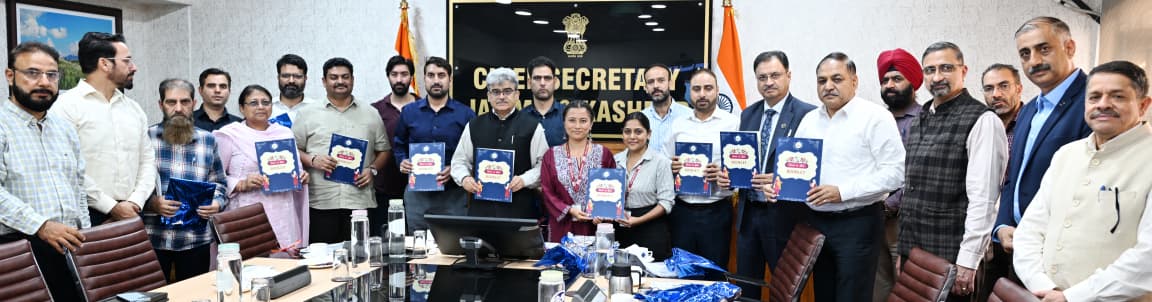
CS for stronger Women-Led Community Institutions to drive rural transformation
Reviews JKRLM performance; Strategy for convergence with other flagship programmes
SRINAGAR, AUGUST 06: Chief Secretary, Atal Dulloo, today chaired a review meeting of the Jammu and Kashmir Rural Livelihoods Mission (JKRLM) and directed the Mission to further strengthen women-led community institutions through enhanced capacity building, institutional reforms and greater convergence with flagship government programmes to accelerate sustainable rural livelihoods across Jammu and Kashmir.
The meeting reviewed the functioning of the Mission with focus on integration with Mission YUVA, operationalisation of Community Managed Training Centres (CMTCs), qualitative assessment of NRLM institutions, strengthening of Self Help Groups (SHGs), Village Level Organisations (VLOs) and Cluster Level Federations (CLFs), besides preparing a comprehensive roadmap for capacity building and institutional development.
The meeting was attended by Managing Director, J&K Bank; Commissioner Secretary, General Administration Department; Commissioner Secretary, School Education Department; Secretary, Labour & Employment Department; Secretary, Rural Development Department; Managing Director, JKRLM; representatives of Kudumbashree National Resource Organisation (NRO), AP-MAS and senior officers of the Mission.
Reviewing the progress of Community Managed Training Centres (CMTCs), the Chief Secretary directed that these centres be made functional in all districts at the earliest and developed into vibrant institutions of social mobilization.
He observed that CMTCs should empower women through regular training and sensitization to play a proactive role in promoting sanitation and hygiene, school enrolment, nutrition, immunization, awareness against drug abuse and other important social issues.
He also asked the department to examine the feasibility of developing these centres into fully functional institutions with dedicated infrastructure and resources under this flagship national mission.
Dulloo further directed the Mission to prepare a structured roadmap for capacity building by creating a pool of master trainers who would subsequently impart training to SHG members at the block level, thereby ensuring sustained institutional strengthening across the Union Territory.
Emphasising convergence with flagship programmes, the Chief Secretary called for close integration of JKRLM with Mission YUVA and the Holistic Agriculture Development Programme (HADP) so that rural women can access entrepreneurship, skill development and self-employment opportunities available under these initiatives.
He directed the Mission to bring nearly six lakh SHG members under these programmes based on their aptitude and interests, while leveraging the services of YUVA Doots to ensure effective outreach, awareness generation and handholding support for enabling beneficiaries to avail the benefits.
Highlighting the successful collaboration with Kudumbashree, the Chief Secretary stressed the need to expand women-led food outlets across districts while strengthening bookkeeping practices through simplified digital modules to enhance financial management of community enterprises.
He also directed the Mission to further enhance bank linkage of SHGs through successive doses of institutional credit to enable expansion of enterprises and sustainable livelihood generation.
The Chief Secretary further called for an independent qualitative assessment of JKRLM by a reputed national-level institution to evaluate its present capacities, identify gaps and recommend measures for strengthening the Mission’s institutional framework and service delivery.
Reviewing the implementation of the Kudumbashree partnership, the Chief Secretary assessed the progress made in supporting SHGs to establish and successfully manage enterprises, particularly the Food Street Associations (FSAs). While appreciating the achievements made so far, he remarked that the initiative holds tremendous potential and called for intensified efforts to further expand its reach and impact across Jammu and Kashmir.
Earlier, the Secretary RDD, Aijaz Asad presented a detailed review of the Mission’s achievements and future roadmap, highlighting significant progress in social mobilization, financial inclusion, livelihoods promotion and convergence-driven rural development under the flagship programme.
Presenting the details the Managing Director, JKRLM, Dr. Shubhra Sharma revealed that JKRLM has established a robust community institutional framework across all 20 districts, 285 blocks and 4,291 Gram Panchayats by mobilizing over 8.14 lakh women into 96,595 Self Help Groups, 7,546 Village Organisations and 652 Cluster Level Federations.
It was further divulged that the Mission has extended capitalization support of over ₹532 crore to community institutions and facilitated cumulative bank credit exceeding ₹3,449 crore through nearly 1.46 lakh credit-linked accounts, while maintaining an exceptionally low NPA level of 0.91 per cent, reflecting sound financial discipline among SHGs.
On livelihoods promotion, it was informed that JKRLM currently supports 7.35 lakh Mahila Kisans across 5,255 villages through an extensive network of more than 3,300 Community Resource Persons, including Krishi Sakhis, Pashu Sakhis and Van Sakhis. The Mission has also digitised farmer training through the Daksh Kisan Portal, where over 64,000 farmers have been enrolled and more than 22,000 successfully certified.
Similarly under the Start-up Village Entrepreneurship Programme (SVEP), the Mission has promoted 11,879 enterprises against a target of 14,244, facilitated bank credit for 1,907 enterprises amounting to over ₹21.77 crore, while utilising ₹20.26 crore under the Community Enterprise Fund.
The meeting was further informed that under the Lakhpati Didi Initiative, 2.40 lakh rural women have already achieved Lakhpati status, while the Mission has prepared a phased strategy to create 3.64 lakh Lakhpati Didis by 2029.
The Mission also shared its future strategy, which envisages development of self-reliant Cluster Level Federations, establishment of regional aggregation centres in Jammu and Srinagar for marketing SHG products, formal registration of CLFs as independent legal entities, expansion of institutional credit for enterprises and deeper convergence with Panchayati Raj Institutions to ensure sustainable and inclusive rural development across Jammu and Kashmir.
CS for stronger Women-Led Community Institutions to drive rural transformation