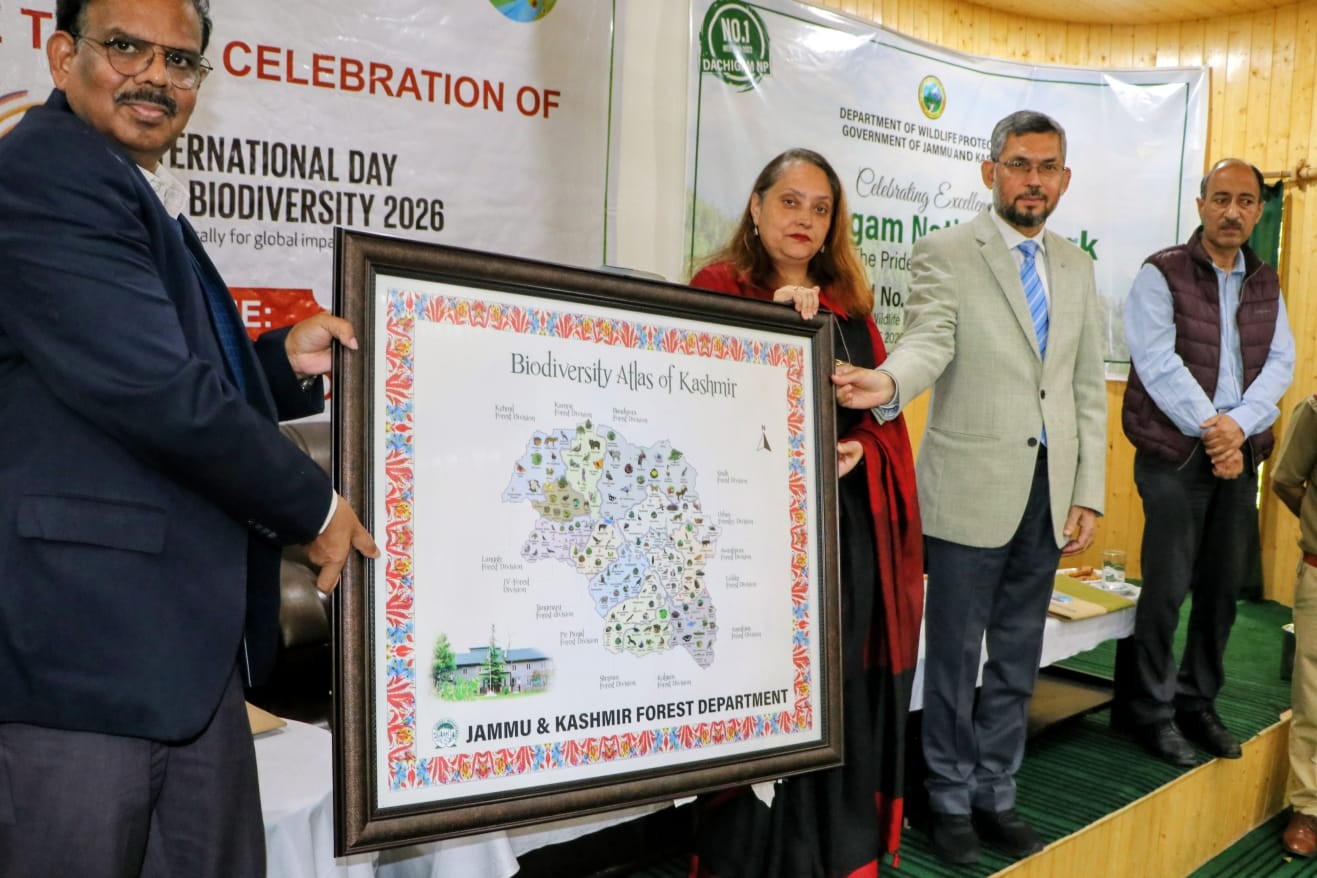
J&K Biodiversity Council celebrates International Day for Biological Diversity
SRINAGAR, MAY 22: The Jammu & Kashmir Biodiversity Council celebrated International Day for Biological Diversity today at Dachigam, highlighting the Union Territory’s rich ecological heritage and reinforcing the global call to “Act Locally, Impact Globally.”
The event was attended by Chief Guest Sheetal Nanda, Commissioner Secretary Forests, Ecology and Environment; Sarvesh Rai, PCCF/HoFF J&K and Chairman J&K Biodiversity Council; Chaturbhuj Bahera PCCF/CWW/Director SFRI and Member Secretary J&K Biodiversity Council; Irfan Rasool Wani, CCF Kashmir; Tawheed Ahmad Deva, Regional Wildlife Warden Kashmir; Saurabh Sharma CF Srinagar; Irfan Ali Shah, CF North and Professor Anzar Khuroo Member Biodiversity Council from Kashmir University, alongside Divisional Forest Officers (DFOs), Range Officers (ROs) and members of various Biodiversity Management Committees (BMCs) from across J&K.
In her address, Sheetal Nanda told the audience that the International Day for Biological Diversity serves as a vital reminder of humanity’s deep dependence on the natural world. “Humans have a core responsibility to conserve biodiversity because our very survival depends on it,” she stated.
The Commissioner Secretary emphasized the critical need to balance infrastructure development with environmental preservation, noting that economic growth must not come at the cost of nature. On this occasion, she directed the Council to prepare a comprehensive catalog of the region’s flora, fauna and avian species and advocated creation of ex-situ (off-site) conservation areas to protect the vulnerable species.
Sarvesh Rai outlined J&K’s unique ecological footprint, noting that 48% of the region’s geographic area is under forest cover, with 25% of that dedicated to Wildlife Protected Areas. He highlighted the vital ecosystem services that forests provide, such as water purification and pollination and pointed out the economic significance of the region’s Non-Timber Forest Products (NTFPs).
“Our local BMCs have successfully collected ₹25 crore over the last three years,” Rai revealed while advocating the sustainable harvesting of medicinal plants to safeguard them for future generations. He also shared positive conservation news, noting that populations of iconic species like the Hangul, Brown Bear, Black Bear and Tiger are steadily bouncing back.
Earlier, Chatturbhuj Bahera highlighted that biodiversity extends far beyond dense forests to include agricultural and cultural diversity, which must be protected to ensure future food security. He spoke on the root causes of human-animal conflict and emphasized the crucial role played by the 2,490 active BMCs across Jammu and Kashmir in documenting the local resources.
Providing a broader scientific context, Professor Anzar Khuroo noted that India is one of only 20 megadiverse countries globally, harboring 4 of the world’s 36 biodiversity hotspots. He detailed the immense richness of the Himalayan ecosystem, which boosts 12,000 flowering plant species, 5,000 of which are found in Kashmir alone. He stressed the need for “course correction” in development practices to achieve true sustainability.
The program concluded with a collective pledge to conserve biodiversity, with the official oath read out by prominent environmentalist Nazir Benazir. Biodiversity atlas of Kashmir was also unveiled on the occasion.
J&K Biodiversity Council celebrates International Day for Biological Diversity