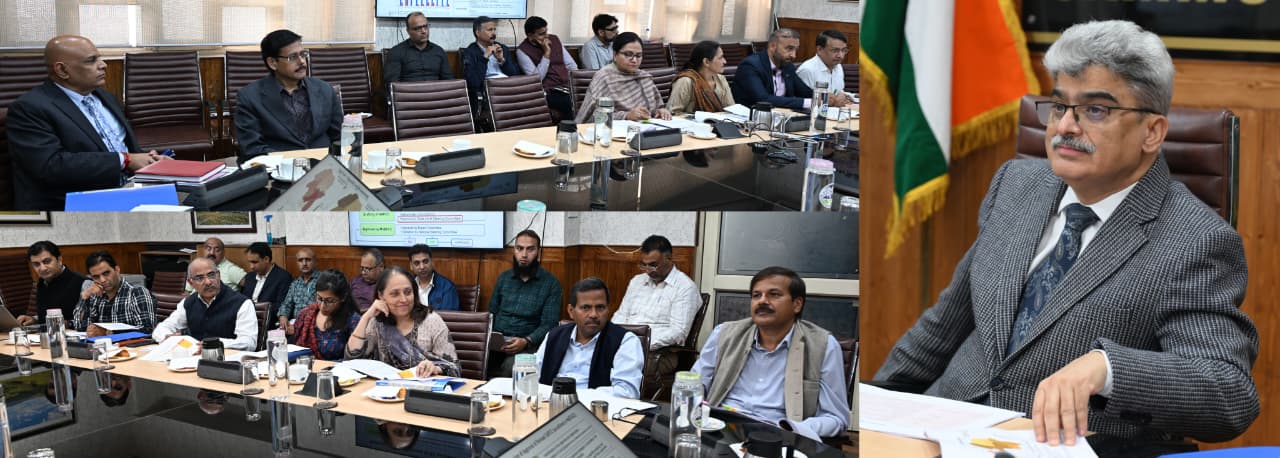
CS assesses revised Climate Action Plan; calls for time-bound departmental action up to 2030
Plan envisages 55 mitigation & 100 adaptation actions across departments
SRINAGAR, OCTOBER 06: Chief Secretary, Atal Dulloo, today chaired a meeting to assess the revised Jammu & Kashmir State Action Plan on Climate Change (SAPCC 2.0), calling for further refinement of the plan by incorporating clearly defined, department-wise actions, outcomes and timelines up to 2030.
The meeting was attended by several Administrative Heads including ACS, PDD; ACS, Tourism; ACS, PWD; Principal Secretary, DMRR&R; Commissioner Secretary, H&ME; Commissioner Secretary, Forests; Secretary, Transport; Principal Chief Conservator of Forests; Representatives from MoEFCC and senior officers of the concerned departments.
The revised SAPCC, prepared by the Department of Forest, Ecology & Environment, seeks to provide a comprehensive framework for strengthening climate resilience in J&K while aligning the Union Territory’s climate response with India’s Nationally Determined Contributions (NDCs), the Paris Agreement and the emerging climate risks specific to the region.
During the meeting, the Chief Secretary emphasised that a climate action plan should translate into clear, actionable and time-bound interventions. He directed the department to incorporate the actions to be undertaken by each concerned department, along with their expected outcomes and milestones, over the period up to 2030.
He observed that every plan should have clearly defined goals and a well-laid-out strategy to achieve them within a specific timeframe. He called for prioritising interventions keeping in view the strengths, constraints, vulnerabilities and available capacities of the UT so that the proposed measures can be implemented effectively on the ground.
The Chief Secretary also stressed greater inter-departmental convergence and dovetailing of climate interventions with ongoing schemes and programmes to optimise resources and avoid duplication of efforts. He called for assigning clear responsibilities and measurable indicators to departments for effective monitoring of progress.
In her presentation, the Commissioner Secretary, Forests, Sheetal Nanda highlighted climate projections based on IPCC pathways, including SSP2-4.5 and SSP5-8.5. She revealed that under the moderate-emission scenario, temperatures are projected to rise by around 1.5°C during 2021–2050, with implications for water resources, agriculture, health and ecosystems.
It was also projected that the annual precipitation is projected to increase by around 5 per cent under the moderate-emission scenario and up to 15 per cent under the high-emission scenario, with the assessment pointing towards shorter cold seasons and greater variability and intensity of rainfall events.
The Commissioner Secretary further detailed out that the climate vulnerability assessment has evaluated 42 indicators across agriculture, water, health and forest sectors, identifying district-specific vulnerabilities and risks to facilitate targeted interventions.
The revised plan proposes 55 emission mitigation strategies, with an estimated mitigation potential of 2.6 million tonnes of CO₂ equivalent by 2030. These include promotion of solar energy, including floating solar plants, greater utilisation of small hydropower and wind energy, strengthening of grid infrastructure, reduction of transmission and distribution losses, promotion of electric mobility and deployment of Intelligent Traffic Management Systems.
Besides, 100 adaptation actions have been proposed across five key sectors along with Disaster Risk Reduction measures. These include expansion of micro-irrigation, achieving universal household tap-water coverage, rainwater harvesting, strengthening health facilities in underserved areas, restoration of degraded catchment forests with native species and construction of retaining walls and other slope-protection measures at vulnerable locations.
The meeting was also informed about the proposed institutional mechanism under SAPCC 2.0, envisaging a Governing Council headed by the Chief Minister to meet annually and an Executive Council chaired by the Chief Secretary to meet twice a year for overseeing implementation and inter-departmental coordination.
Implementation of the action plan is proposed to be monitored quarterly through a digital dashboard, with departmental nodal officers updating defined Key Performance Indicators (KPIs) to track progress against targets.
The Chief Secretary directed that the revised framework should clearly establish who will do what, by when and with what measurable outcome, while ensuring that the interventions are aligned with J&K’s specific ecological, geographical and socio-economic realities.
The revised SAPCC 2.0 is proposed to be placed before the State Level Steering Committee (SLSC) for formal approval before its submission to the National Level Steering Committee under the Ministry of Environment, Forest and Climate Change (MoEF&CC) for its early implementation on ground.
CS assesses revised Climate Action Plan; calls for time-bound departmental action up to 2030 Plan envisages 55 mitigation & 100 adaptation actions across departments