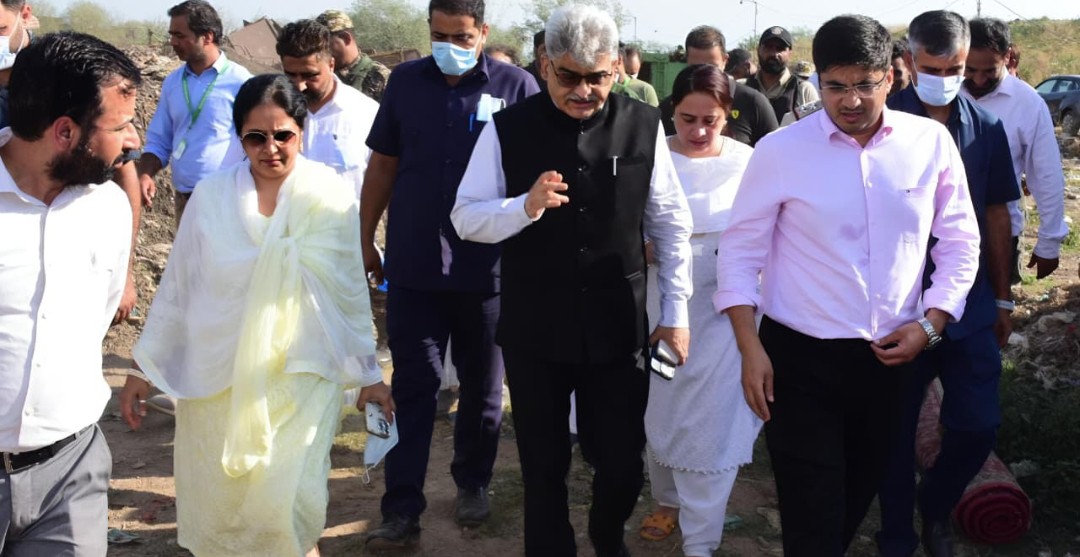
Srinagar, July 16 (KINS): Chief Secretary Atal Dulloo on Thursday reviewed the scientific waste management system and environmental sustainability initiatives at the Achan Integrated Waste Management Facility, assessing the progress of key projects being implemented by the Srinagar Municipal Corporation (SMC) for scientific processing, treatment and eco-friendly disposal of municipal solid waste.
The Chief Secretary was accompanied by Commissioner Secretary, Housing and Urban Development Department, Mandeep Kaur; SMC Commissioner Faz Lul Haseeb; Joint Commissioners of the SMC and other senior officers.
During the visit, Dulloo inspected various components of Srinagar’s integrated solid waste management system, including door-to-door waste collection, source segregation, transportation, scientific processing of municipal waste, biomining and reclamation of legacy waste, leachate treatment facilities, environmental monitoring and compliance with statutory environmental norms.
Officials briefed the Chief Secretary on ongoing efforts to expand and modernise waste processing infrastructure, adopt advanced technologies and improve operational efficiency under the Swachh Bharat Mission (Urban) 2.0.
SMC Commissioner Faz Lul Haseeb informed the Chief Secretary that the Corporation has undertaken several measures to strengthen the city’s waste management system through infrastructure expansion, improved source segregation, mechanised collection and transportation, scientific waste processing and technology-based monitoring.
He said the Corporation is also implementing scientific bioremediation and reclamation of legacy waste at the Achan dumpsite under the Swachh Bharat Mission (Urban) 2.0. The initiative aims to clear decades-old accumulated waste, reclaim land, reduce greenhouse gas emissions, prevent groundwater contamination and improve the area’s environmental quality.
Appreciating the progress made by the SMC, the Chief Secretary stressed the need for sustained efforts in scientific waste management, timely infrastructure augmentation, faster remediation of legacy waste, strict adherence to environmental norms and wider adoption of innovative technologies for efficient waste processing and resource recovery.
He also underscored the importance of inter-departmental coordination, regular monitoring and public participation in achieving long-term environmental sustainability and improved urban sanitation.
Reiterating that scientific management of municipal solid waste is essential for building cleaner, healthier and sustainable cities, Dulloo called for collective efforts to strengthen environmental governance, improve public service delivery and safeguard natural resources.
The visit reaffirmed the Jammu and Kashmir Government’s commitment, in collaboration with the Srinagar Municipal Corporation and other stakeholders, to enhance scientific waste management practices and promote sustainable urban development for a cleaner and greener Srinagar.(KINS)
Chief Secretary reviews scientific waste management initiatives at Achan facility